
For years, we’ve been told that AI is going to revolutionize the way we work. But if you’ve actually tried to implement it in your business, you know the reality is often underwhelming. You end up with a chatbot that can answer basic questions but can’t actually do anything. It’s a passive observer, not an active participant in your workflow.
That’s about to change.
Zoho has officially stepped into the future with the Model Context Protocol (MCP). This isn't just another incremental update; it is a fundamental shift in how your business software communicates with Artificial Intelligence. At ZoGenie, we see this as the "USB-C moment" for AI agents. It provides a standardized way for Large Language Models (LLMs) like Claude or GPT to plug directly into your Zoho CRM automation and start executing tasks autonomously.
If you’ve been struggling with rigid, brittle automations, Zoho MCP is the answer you’ve been looking for.
What Exactly is Zoho MCP?
The Model Context Protocol (MCP) is an open standard that allows developers to provide context and tools to AI models in a secure, consistent way. In the context of the Zoho ecosystem, it means your AI agents no longer have to "guess" what your data looks like or wait for you to manually trigger a Zoho function.
Instead of you writing a specific script for every possible scenario, you give the AI access to the MCP server. The AI can then browse your CRM data, understand the relationships between leads and deals, and trigger actions based on natural language instructions.
Think of it this way: Traditional automation is a train on a track. It can only go where the tracks are laid. Zoho MCP is like a self-driving car. You tell it the destination, and it navigates the streets, avoids traffic, and finds the best route on its own.

Why Traditional Zoho CRM Automation Often Falls Short
Don't get us wrong, we love standard custom zoho workflows. They are the bread and butter of a healthy CRM. But they have limitations:
- They are Reactive: Standard workflows wait for a "trigger" (like a field update) to perform a "fixed action."
- They Lack Context: A workflow doesn't know that a customer is unhappy based on a recent email; it only knows that a "Status" field was changed.
- Maintenance Heavy: As your business grows, you end up with hundreds of workflows that are hard to manage and often conflict with each other.
Zoho MCP solves this by moving the logic from "If-This-Then-That" to "Goal-Oriented Reasoning." You aren't just automating a click; you are automating a decision-making process.
How Zoho MCP Powers Up Your CRM
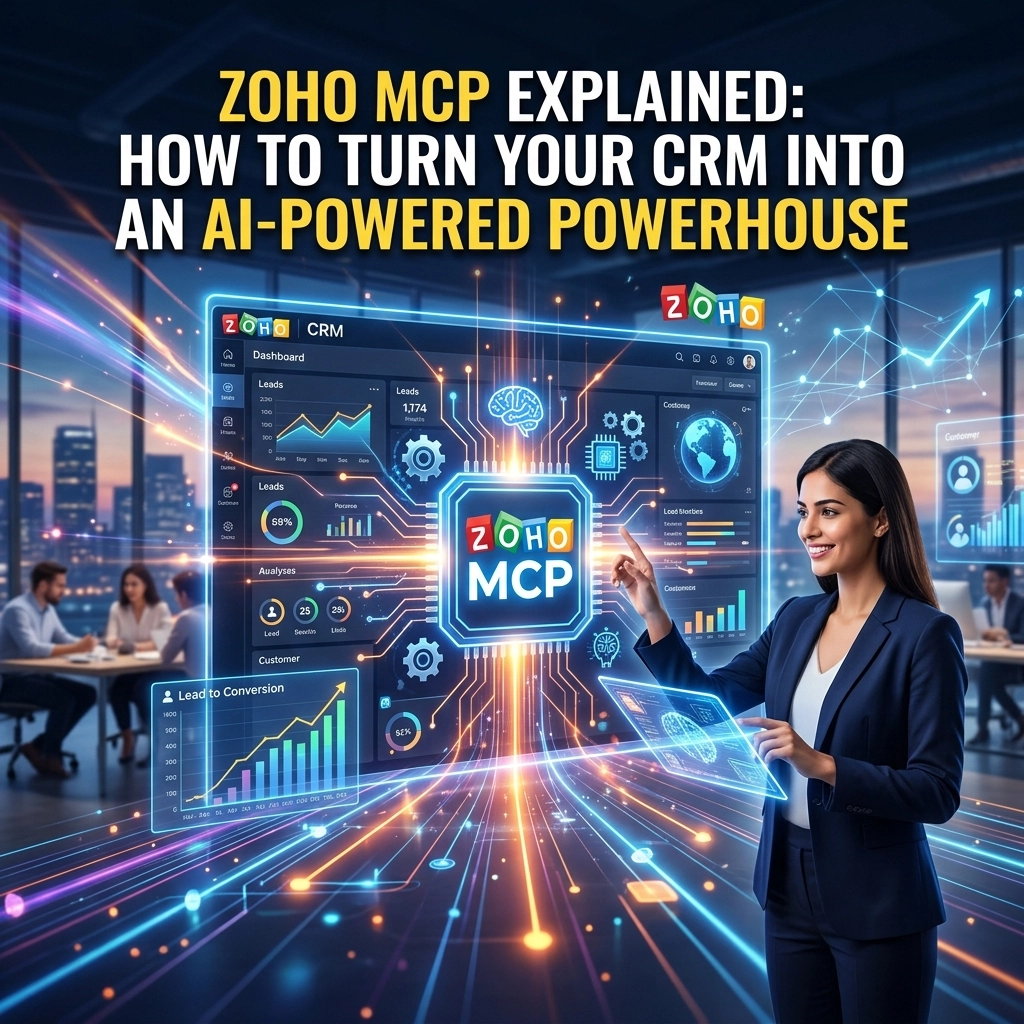
When you implement MCP, your CRM transforms from a static database into an active engine. Here is how it changes the game for your team.
1. Autonomous Task Execution
The biggest hurdle in zoho crm automation has always been the hand-off between AI insights and actual execution. With MCP, an AI agent can identify a lead that hasn't been contacted in three days, read their previous interactions, and autonomously draft and send a personalized follow-up email. It doesn't just suggest the action; it performs it.
2. Seamless Integration Across the Zoho Suite
Zoho MCP isn't limited to just the CRM. It acts as a bridge across the entire Zoho ecosystem, Books, Projects, Desk, and more. If an AI agent sees a project in Zoho Projects is running over budget, it can check Zoho Books for financial data and then update the deal status in the CRM automatically. This level of cross-app intelligence was previously only possible with complex, expensive custom integrations.
3. Real-Time Data Context
AI models are only as good as the data they can see. MCP provides a secure channel for the model to query your CRM in real-time. Whether it's looking up a Zoho function to calculate a discount or checking the latest support tickets in Zoho Desk, the AI has the full context of the customer journey before it speaks or acts.

The Technical Core: How It Works
For the implementers and tech-savvy owners, here is the breakdown. Zoho MCP utilizes JSON-RPC 2.0 for communication. This is a lightweight protocol that allows the AI to send "requests" to the Zoho server and receive "responses" in a structured format.
Security is handled via OAuth 2.0, ensuring that the AI agent only has access to the data you specifically authorize. You aren't just opening the doors to your data; you are giving the AI a very specific set of keys to perform very specific tasks.
By using a Zoho function as a tool within the MCP framework, you can bridge the gap between AI reasoning and legacy code. You can define a custom function that handles complex pricing logic and then "hand" that tool to the AI. The AI decides when and why to use it, but your pre-defined code ensures the how is always accurate.
Real-World Use Cases for Zoho MCP
What does this look like in a daily business environment? Here are three scenarios where Zoho MCP outperforms traditional methods.
Scenario A: The Proactive Sales Assistant
Instead of a sales rep spending two hours every morning "cleaning" their pipeline, an AI agent using MCP can scan all active deals. It identifies which deals are stalling, checks the last time a document was signed in Zoho Sign, and notifies the rep: "Hey, the contract for ABC Corp has been sitting for 48 hours. I've drafted a nudge email for you to review."
Scenario B: Intelligent Support Escalation
Customer support can be a pain when tickets pile up. An MCP-powered agent can monitor Zoho Desk. If a high-value client submits a ticket with "Urgent" sentiment, the agent can automatically escalate the ticket, create a task for the account manager in the CRM, and pull the last three months of interaction history so the manager is ready to respond immediately.
Scenario C: Automated Revenue Operations (RevOps)
Managing renewals is often a manual nightmare. With custom zoho workflows enhanced by MCP, an AI can monitor contract end dates. It can check if the client has been active in your software, look for any outstanding invoices in Zoho Books, and trigger a renewal sequence that is tailored to that specific client’s usage patterns.

Getting "Agent-Ready" with ZoGenie
Transitioning to an AI-powered CRM isn't just about flipping a switch. It requires a clean data structure and a strategic approach to your custom zoho workflows. If your data is a mess, your AI will be a mess.
At ZoGenie, we help businesses bridge this gap. We don't just implement software; we build the infrastructure that allows these new AI protocols to actually work. Whether you are looking to optimize your current setup or want to build a fully autonomous sales engine from scratch, we have the expertise to make it happen.
You can learn more about our approach on our About Us page or see how we’ve helped other clients by browsing our Testimonials.
The Bottom Line
The era of clicking and dragging your way through a CRM is coming to an end. Zoho MCP is the foundation for a more intelligent, autonomous way of doing business. By standardizing the way AI interacts with your data, Zoho has made it easier than ever to build a CRM that doesn't just store information but actually works for you.
If you aren't looking into MCP and AI agents today, you are going to be playing catch-up tomorrow. The efficiency gains are too large to ignore.
Ready to turn your CRM into an AI-powered powerhouse?
Don't let your automation become a bottleneck. Contact us at ZoGenie today, and let's discuss how we can implement Zoho MCP to streamline your business and give your team their time back.
For more insights into the evolving world of business software, check out our latest posts on the ZoGenie Blog or explore our recent Projects.